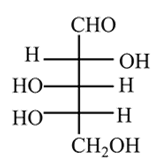
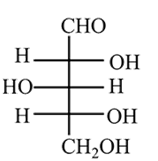
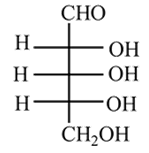
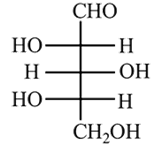
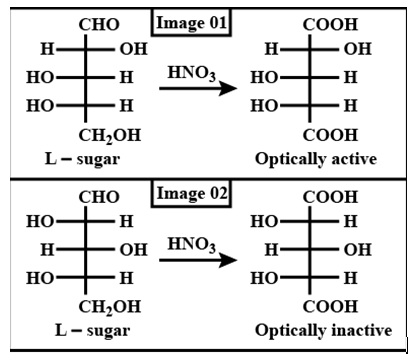
Which L-sugar on oxidation gives an optically active dibasic acid ( 2 COOH groups)?
Which L-sugar on oxidation gives an optically active dibasic acid ( 2 COOH groups)?
Solution
Any sugar will be optically active when it does not have any plane of symmetry. As only (a) \& (d) are L-sugar, (b) \& (c) are D-sugar after oxidation.
(a) (Refer to Image 1) - The product do not superimpose in its mirror image.
(d) (Refer to Image 2) - As it has plane of symmetry.