Two infinitely long straight wires lie in the xy - plane along the lines x = ± R . The wire located at…
- If cannot be equal to zero at the origin
- If can be equal to zero at the origin
- If can be equal to zero at the origin
- If , Then the z-component of the magnetic field at the centre of the loop is \((-\mu 0 \mathrm{I} / 2 \mathrm{R})\)
Solution
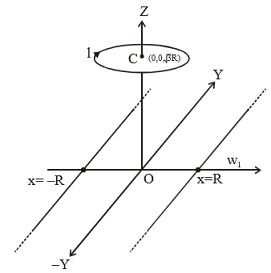 At origin, due to two wires if at origin is equal to due to ring, which is non-zero.
If at origin due to wires will be along direction and due to ring is along direction and hence can be zero at origin
If at origin due to wires is along and also along due to ring, hence cannot be zero
At origin, due to two wires if at origin is equal to due to ring, which is non-zero.
If at origin due to wires will be along direction and due to ring is along direction and hence can be zero at origin
If at origin due to wires is along and also along due to ring, hence cannot be zero
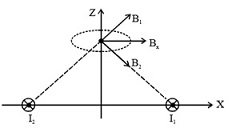 (D) \(\underset{\text { (along z axis) }}{\vec{B}_C}=\frac{\mu_0 I}{2 R}(-\hat{k})\)
Asked in: JEE Advanced 2018 (Paper 1)
Practice more Magnetic Fields due to Electric Current questions on Aicharya