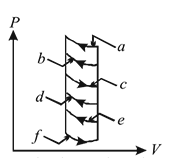
The P-V diagram here shows six curved paths (connected by vertical paths) that can be followed by a gas.…
The P-V diagram here shows six curved paths (connected by vertical paths) that can be followed by a gas. Which two of the curved paths should be part of a closed cycle (those curved paths plus connecting vertical paths) if the net work done by the gas during the cycle is to be at its maximum positive value?
$a- f$
$a -e$
$c-e$
$b-f$
Solution
The area under the \(\mathrm{P}-\mathrm{V}\) graph represents the amount of work done.
We also know when in a process the initial state has a higher volume than the final state then the work done by the gas in that process is negative (any process which flows from right to left in a P-V graph represents negative work).
\(\Rightarrow \left.\substack{\text{work done in } a<0 \\ \text{work done in } c>0} ight\} \ldots (i)\)
The process which happens at a higher level in the P-V graph (further away from the x -axis) will have a higher magnitude of work done, compared to a process at a lower level -
\(=\) Work done in a > Work done in b.- . . . . (2)
So to find a cycle which has maximum positive work done, we can infer that the process on the top of the cycle must flow from left to right, and must be as far away as possible from the x -axis. Process c is ideal for this.
The process which forms the bottom of the cycle needs to be as close as possible to the \(x\)-axis and must flow from right to left.
Process e is best suited for these requirements.
Hence the cycle completed by c - e would have maximum positive work done amongst the options.