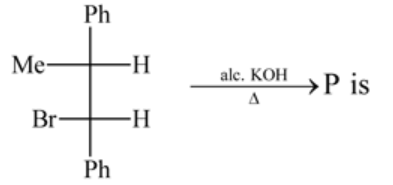
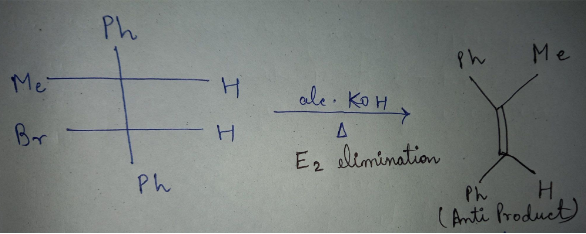
We must know that the Haloalkane in the presence of alcoholic $K O H$ undergoes elimination reactions. For example:
$\left.\mathrm{CH}_{3} \mathrm{CH}_{2} \mathrm{Br}+\mathrm{KOH} \text { (alc. }ight) \Rightarrow \mathrm{H}_{2} \mathrm{C}=\mathrm{CH}_{2}+\mathrm{KBr}+\mathrm{H}_{2} \mathrm{O}$
Alcoholic potassium hydroxide, $K O H$ solution that functions as solvent gives alkoxide ions that act as a strong base. This base abstracts $\beta$-Hydrogen atom from saturated substrate - alkyl halide.
Abstracted $\beta$-Hydrogen atom is then transferred to the alkyl part to form an alkane and simultaneously a molecule of $H C l$ is eliminated.
The basicity of hydroxide ions is considerably lower than the basicity of alkoxide ions. Hydroxide ion is significantly getting hydrated in aqueous solution. Hence, hydroxide ions cannot abstract $\beta$-hydrogen atoms of alkyl chloride to eliminate $H C l$ and form alkene.
*
 *
*