The electronegativity difference between $\mathrm{N}$ and $\mathrm{F}$ is greater than that between…
- in $\mathrm{NH}_{3}$ the atomic dipole and bond dipole are in the same direction whereas in $\mathrm{NF}_{3}$ these are in opposite directions.
- in $\mathrm{NH}_{3}$ as well as $\mathrm{NF}_{3}$ the atomic dipole and bond dipole are in opposite directions.
- in $\mathrm{NH}_{3}$ the atomic dipole and bond dipole are in the opposite directions whereas in $\mathrm{NF}_{3}$ these are in the same direction.
- in $\mathrm{NH}_{3}$ as well as in $\mathrm{NF}_{3}$ the atomic dipole and bond dipole are in the same direction.
Solution
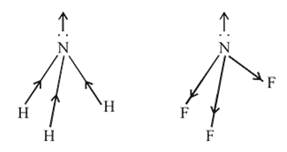 ,
,Asked in: JEE-TOPICTESTS-CHEMISTRY
Practice more CHEMICAL BONDING AND MOLECULAR STRUCTURE questions on Aicharya