The bond dissociation energy of $\mathrm{B}-\mathrm{F}$ in $\mathrm{BF}_{3}$ is $646 \mathrm{~kJ}…
- stronger $\sigma$ bond between $\mathrm{B}$ and $\mathrm{F}$ in $\mathrm{BF}_{3}$ as compared to that between $\mathrm{C}$ and $\mathrm{F}$ in $\mathrm{CF}_{4}$.
- significant $p \pi-p \pi$ interaction between $\mathrm{B}$ and $\mathrm{F}$ in $\mathrm{BF}_{3}$ whereas there is no possibility of such interaction between $\mathrm{C}$ and $\mathrm{F}$ in $\mathrm{CF}_{4}$.
- lower degree of $p \pi-p \pi$ interaction between $\mathrm{B}$ and $\mathrm{F}$ in $\mathrm{BF}_{3}$ than that between $\mathrm{C}$ and $\mathrm{F}$ in $\mathrm{CF}_{4}$.
- smaller size of B-atom as compared to that of $\mathrm{C}$ -atom.
Solution
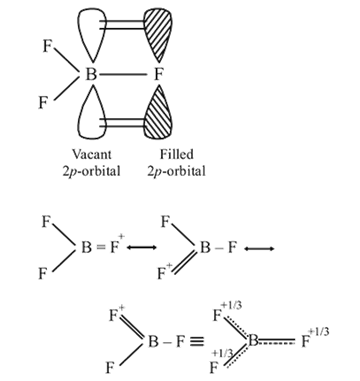
Asked in: JEE-TOPICTESTS-CHEMISTRY
Practice more CHEMICAL BONDING AND MOLECULAR STRUCTURE questions on Aicharya