Six charges are placed around a regular hexagon of side length a as shown in the figure. Five of them have…

Six charges are placed around a regular hexagon of side length a as shown in the figure. Five of them have charge q, and the remaining one has charge x. The perpendicular from each charge to the nearest hexagon side passes through the center O of the hexagon and is bisected by the side.
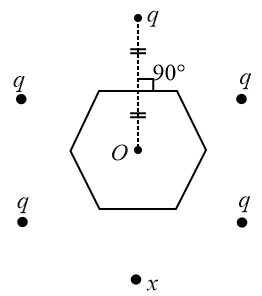
Which of the following statement(s) is(are) correct in SI units?

  1. When x=q, the magnitude of the electric field at O is zero.
  2. When x=-q, the magnitude of the electric field at O is q6π0a2.
  3. When x=2q, the potential at O is 7q43π0a.
  4. When x=-3q, the potential at O is -3q43πϵ0a.

Solution

$\Rightarrow$ Electric field at $O$ would be zero. $\Rightarrow A$ is correct. When $x=-q$, we can think of $x$ as $q+(-2q)$. Therefore, the magnitude of the electric field will be equivalent to that if only charge of $-2q$ is kept at the the bottom point. Hence, $E_O = \frac{1}{4\pi\epsilon_0} \frac{2q}{(\sqrt{3}a)^2} = \frac{1}{4\pi\epsilon_0} \frac{2q}{3a^2} = \frac{q}{6\pi\epsilon_0 a^2}$ $\Rightarrow B$ is correct For $x=2q$, potential at $O$ is $V_O = 5 \times \frac{1}{4\pi\epsilon_0} \frac{q}{\sqrt{3}a} + \frac{1}{4\pi\epsilon_0} \frac{2q}{\sqrt{3}a} = \frac{7q}{4\sqrt{3}\pi\epsilon_0 a}$ $\Rightarrow C$ is correct For $x=-3q$, $V_O = 5 \times \frac{1}{4\pi\epsilon_0} \frac{q}{\sqrt{3}a} + \frac{1}{4\pi\epsilon_0} \frac{-3q}{\sqrt{3}a} = \frac{q}{2\sqrt{3}\pi\epsilon_0 a}$ $\Rightarrow D$ is not correct.

Asked in: JEE Advanced 2022 (Paper 1)

Practice more Electrostatics questions on Aicharya