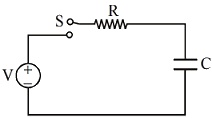
Paragraph: Consider a simple $R C$ circuit as shown in Figure $1$. Process 1: In the circuit the switch $S$…
Paragraph:
Consider a simple $R C$ circuit as shown in Figure $1$.
Process 1: In the circuit the switch $S$ is closed at $t=0$ and the capacitor is fully charged to voltage $V_{0}$ (i.e., charging continues for time $T>>R C$). In the process some dissipation $\left(E_{D}\right)$ occurs across the resistance $R$. The amount of energy finally stored in the fully charged capacitor is $E_{C}$.
Process 2: In a different process the voltage is first set to $\frac{V_{0}}{3}$ and maintained for a charging time $T>>R C$. Then the voltage is raised to $\frac{2 V_{0}}{3}$ without discharging the capacitor and again maintained for a time $T>>R C$. The process is repeated one more time by raising the voltage to $V_{0}$ and the capacitor is charged to the same final voltage $V_{0}$ as in Process 1.
These two processes are depicted in Figure $2 .$
Question:
In Process 1, the energy stored in the capacitor $E_{C}$ and heat dissipated across resistance $E_{D}$ are related by:
\(E_C=E_D\)
\(E_C=E_D \ln 2\)
\(E_C=\frac{1}{2} E_D\)
\(E_C=2 E_D\)
Solution
When switch is closed for a very long time capacitor will get fully charged and charge on capacitor will be Energy stored in capacitor .....(i) Work done by battery Dissipated across resistance = (work done by battery) – (energy store) .....(ii) From (i) and (ii)
`

 Question:
In Process 1, the energy stored in the capacitor $E_{C}$ and heat dissipated across resistance $E_{D}$ are related by:
Question:
In Process 1, the energy stored in the capacitor $E_{C}$ and heat dissipated across resistance $E_{D}$ are related by: