Nickel \((Z=28)\) combines with a uninegative monodentate ligand to form a diamagnetic complex…
Nickel \((Z=28)\) combines with a uninegative monodentate ligand to form a diamagnetic complex \(\left[\mathrm{NiX}_{4}ight]^{2-}\). The hybridization involved and the number of unpaired electrons present in the complex is respectively:
\(\mathrm{sp}^{2}\), two
\(\mathrm{dsp}^{2}\), zero
\(\mathrm{dsp}^{2}\), one
\(\mathrm{sp}^{3}\), zero
Solution
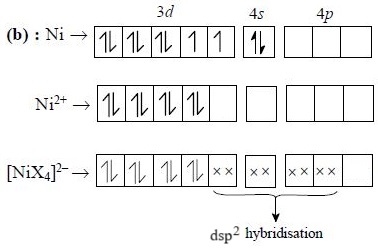
Monodentate ligand is uninegative and hence, the oxidation number of Ni in \(\left[\mathrm{NiX}_{4}ight]^{2-}\) is \(+2\).
The electronic configuration of \(\mathrm{Ni}^{2+}\) is \([\mathrm{Ar}] 3 \mathrm{~d}^{8}\).
If the compound is diamagnetic it means all the electrons are paired. Hence, there will be one \(3 \mathrm{~d}\) orbital empty and one \(4 \mathrm{~s}\) orbital empty.
The hybridisation involved in the formation of complex \(\left[\mathrm{NiL}_{4}ight]^{2-}\) is \(\mathrm{dsp}^{2}\).
^
 ^
^