Match the reactions in List-I with the features of their products in List-II and choose the correct option.…

Match the reactions in List-I with the features of their products in List-II and choose the correct option.

  List I   List II
(P)

--1-Bromo-2-ethylpentane(Single enantiomer)  SN 2  reactionaqNaOH

1 Inversion of configuration
(Q) --2-BromopentaneSingle Enantiomer  SN 2 reactionaqNaOH     2 Retention of configuration
(R) --3-Bromo-3- methylhexane Single Enatiomer   SN1aq.NaOH 3 Mixture of enantiomers
(S) 4 Mixture of structural isomers
    5 Mixture of diastereomers


  1. P  1; Q  2; R  5; S  3
  2. P  2; Q  1; R  3; S  5
  3. P1; Q2; R5; S4
  4. P  2; Q  4; R  3; S  5

Solution

1-Bromo-2-ethylpentane(Single enantiomer)  SN 2  reactionaqNaOH2-ethylpentanol

In the above reaction the chiral carbon is not involving in the reaction as SN2 reaction takes place via formation of transition state but not through formation of intermediate.

In the above reaction, bromine attached to chiral carbon, and it is involving in SN2 reaction. Hence, the alcohol formed in inversion configuration.
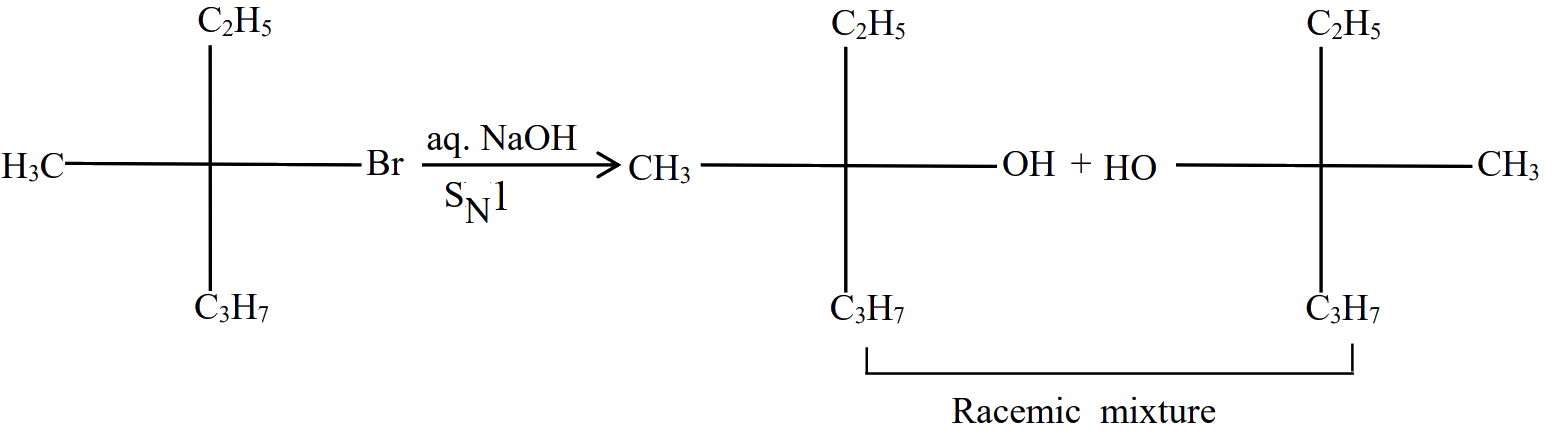
The substrate is undergoing SN1 reaction. It takes place via formation of carbocation. Carbocation as planar, hence, the alcohol product formed is racemic mixture as nucleophile can attack from both the planes.

The substrate is undergoing SN1  reaction. It takes place via formation of carbocation. Carbocation as planar, hence, the two alcohol products are formed as nucleophile can attack from both the planes but the substrate already having the chiral centre, the mixture formed is diastereomeric mixture.
 

Asked in: JEE Advanced 2023 (Paper 1)

Practice more Halogen Derivatives questions on Aicharya