Let f x = x + log e ⁡ x - x log e ⁡ x , x ∈ 0 ,   ∞ .   • Column 1…

Let fx=x+logex-xlogex,x0, . 
   Column 1 contains information about zeros of fx, fx and fx.
   Column 2 contains information about the limiting behaviour of fx, fx and fx at infinity.
   Column 3 contains information about increasing-decreasing nature of fx and fx.
 
Column 1 Column 2 Column 3
(I) fx=0 for some x1, e2 (i) limxfx=0 (P) f is increasing in (0, 1)
(II) fx=0 for some x in 1, e (ii) limxfx=- (Q) f is decreasing in e, e2
(III) fx=0 for some x0, 1 (iii) limxfx=- (R) f is increasing in (0, 1)
(IV) fx=0 for some x1, e (iv) limxfx=0 (S) f is decreasing in e, e2
Which of the following options is the only Incorrect combination?
  1. (II) (iv) (Q)
  2. (III) (i) (R)
  3. (I) (iii) (P)
  4. (II) (iii) (P)

Solution

fx=x+nx-xnx, x>0

f'x=1+1x-nx-1

f''x= -1x2-1x=-x+1x2

(I)  f1 fe2<0, so true.

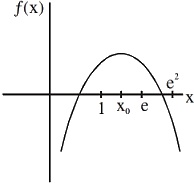
(II) f'1 f'e<0,so true.

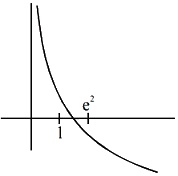
(III) Graph of f'x , so (III) is false as the curve does not intersect X-axis i.e, f'(x)0 when x(0,1)

(IV) Is false. f''(x)0 as tangent to the curve of f'(x) is not parallel to X-axis.

As   limxfx= limxx1+n xx- n x= -

  (i) is false (ii) is true

limxf'x= -, so (iii) is true

limxf''x=0 , so (iv) is true.

(P)  f'x, is positive in(0, 1), so true.

(Q)  f'x<0, for in e, e2, so true.

As  f"x<0  x>0 therefore, R is false, S is true.

Alternate:

fx=x+ n x-xn x

f'x=1x-n x=0 at x=x0 where x01, e

f''x= -1x2-1x<0  x>0   fx  concave down

Asked in: JEE Advanced 2017 (Paper 1)

Practice more Applications of Derivatives questions on Aicharya