In the adjoining figure, BE and CE are bisectors of \(\angle\text{ABC}\) and \(\angle\text{ACD}\) respectively. If \(\angle\text{BEC}=25^\circ\) then \(\angle\text{BAC}\) is equal to:
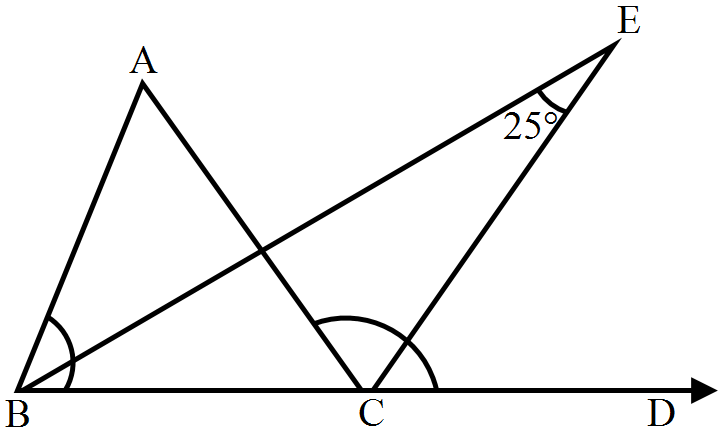
In the adjoining figure, BE and CE are bisectors of \(\angle\text{ABC}\) and \(\angle\text{ACD}\) respectively. If \(\angle\text{BEC}=25^\circ\) then \(\angle\text{BAC}\) is equal to:
\(65^\circ\)
\(12\frac{1}{2}^\circ\)
\(25\frac{1}{2}^\circ\)
\(50^\circ\)
Asked in: School