
In the following common emitter circuit, if $\beta=100, V_{C E}=-7 \mathrm{~V}, V_{B E}$ is negligible,…
- $0.01 \mathrm{~mA}$
- $0.04 \mathrm{~mA}$
- $0.02 \mathrm{~mA}$
- $0.03 \mathrm{~mA}$
Solution
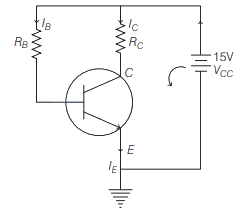
We know that, the current gain in common emitter circuit is $ \beta=I_C / I_B...(i) $ By KVL in right loop, $V_{C C}-I_C R_C+V_{C E}=0$ Substituting the values, we get $ \begin{aligned} 15-I_c(2000)-7 & =0 \\ I_C & =\frac{8}{2000}=4 \mathrm{~mA}...(ii) \end{aligned} $ Putting value of $I_C$ in Eq. (i), we get $ \begin{aligned} & \beta=4 / I_B \Rightarrow 100=4 / I_B \\ & I_B=\frac{4}{100} \mathrm{~mA}=0.04 \mathrm{~mA} \end{aligned} $
Asked in: AP EAMCET 2021 (24 Aug Shift 1)