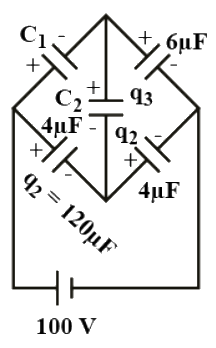
In the circuit shown, \(q_2\) and \(q_3\) are respectively.
- \(q_2=120 \mu C, q_3=\text { zero }\)
- It is impossible to find \(q_2\) and \(q_3\) unless \(C_1\) and \(C_2\) are known
- \(q_2=120 \mu C, q_3=240 \mu C\)
- \(q_2=280 \mu C, q_3=-160 \mu C\)
Solution
To find \(q_2\) and \(q_3\).
Applying kirchoff voltage law 2-
\(\begin{aligned}
& 100-\frac{120}{4}-\frac{q_2}{4}=0 \\
& \frac{q_2}{4}=70 \Rightarrow q_2=280 \mu \mathrm{C}
\end{aligned}\)
Also, \(q_2+q_3=q_1 \Rightarrow 280+q_3=120\)
\(\therefore q_3=-160 \mu \mathrm{C} .\)
/Asked in: JEE Mains - Capacitance - Chapter Test