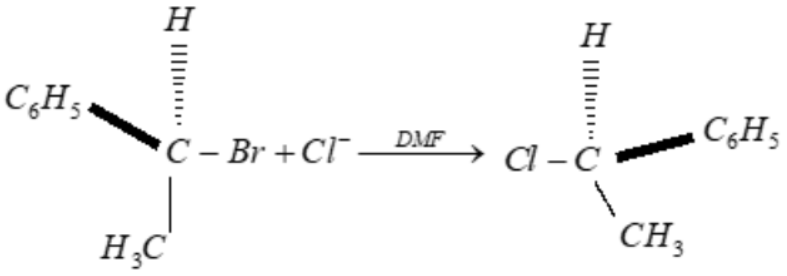
In a nucleophilic substitution reaction: $\mathrm{R}-\mathrm{Br}+\mathrm{Cl}^{-}…
In a nucleophilic substitution reaction: $\mathrm{R}-\mathrm{Br}+\mathrm{Cl}^{-} \stackrel{\mathrm{DMF}}{ightarrow} \mathrm{R}-\mathrm{Cl}+\mathrm{Br}^{-}$, which one of the following undergoes complete inversion of configuration?
\(\mathrm{C}_6 \mathrm{H}_5 \mathrm{CHBrCH}_3\) Being an optically active secondary alkyl bromide undergoes \(S_N 2\) nucleophilic substitution reaction. Hence it undergoes complete inversion of configuration.