For $\mathrm{H}_{3} \mathrm{PO}_{3}$ and $\mathrm{H}_{3} \mathrm{PO}_{4}$, the correct choice is
- $\mathrm{H}_{3} \mathrm{PO}_{3}$ is dibasic and reducing
- $\mathrm{H}_{3} \mathrm{PO}_{4}$ is diabasic and non-reducing
- $\mathrm{H}_{3} \mathrm{PO}_{4}$ is tribasic and reducing
- $\mathrm{H}_{3} \mathrm{PO}_{3}$ is tribasic and reducing
Solution
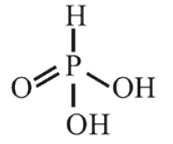
There are only two-OH groups and hence it is dibasic. The oxidation number of $\mathrm{P}$ in this acid is $+3$, whereas $\mathrm{P}$ may have $+5$ oxidation state also. Therefore, $\mathrm{H}_{3} \mathrm{PO}_{3}$ can be oxidised which means $\mathrm{H}_{3} \mathrm{PO}_{3}$ is a reducing agent.
Asked in: JEE-TOPICTESTS-CHEMISTRY
Practice more P-BLOCK ELEMENTS GROUP 15 16 17 18 questions on Aicharya