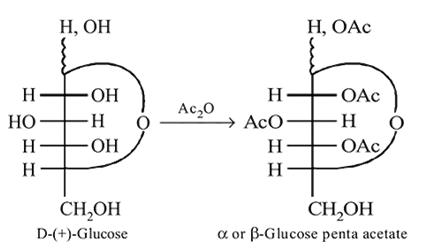
$\mathrm{D}-(+)$ -Glucose $\stackrel{5\left(\mathrm{CH}_{3} \mathrm{CO}ight)_{2} \mathrm{O}}{\longrightarrow} \mathrm{D}-(+)$ -Glucose pentaacetate
Which statement is true about glucose pentaacetate?
It will react with phenylhydrazine but not with Tollens' reagent.
It will react with Tollens' reagent but not with phenylhydrazine.
It will react with both of the above mentioned reagents.
It will react neither with phenylhydrazine nor with Tollens' reagent.
Solution
During acetylation of $(+)$ -glucose, it is the $\mathrm{C}_{1}-\mathrm{OH}$ of the hemiacetal that is acetylated and not the $\mathrm{C}_{5}-\mathrm{OH}$ that forms the ring (cyclic structure). Since equilibrium with the open-chain aldehyde is prevented, the penta-acetate does not respond the aldehydic reactions.
~
 ~
~