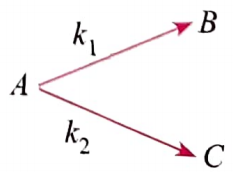
Consider the reaction. The rate constant for two parallel reaction were found to be $10^{-2} \mathrm{dm}^{3}…
Consider the reaction.
The rate constant for two parallel reaction were found to be $10^{-2} \mathrm{dm}^{3} \mathrm{~mol}^{-1} \mathrm{~s}^{-1}$ and $4 \times 10^{-2} \mathrm{dm}^{3} \mathrm{~mol}^{-1} \mathrm{~s}^{-1}$. If the corresponding energies of activation of the parallel reaction are 100 and $120 \mathrm{~kJ} / \mathrm{mol}$ respectively, what is the net energy of activation $\left(E_{a}ight)$ of $A ?$
$100 \mathrm{~kJ} / \mathrm{mol}$
$120 \mathrm{~kJ} / \mathrm{mol}$
$116 \mathrm{~kJ} / \mathrm{mol}$
$220 \mathrm{~kJ} / \mathrm{mol}$
Solution
Net energy of activation $\left(\mathrm{E}_{\mathrm{a}}ight)$ of $\mathrm{A}$ is $\mathrm{K}_{1} \times \frac{\mathrm{E}_{\mathrm{a} 1}}{\mathrm{~K}_{\mathrm{av}}}+$
$\mathrm{K}_{2} \times \frac{\mathrm{E}_{\mathrm{a} 2}}{\mathrm{~K}_{\mathrm{av}}}=\frac{1}{4} \times 100+\frac{4}{5} \times 120=116 \mathrm{~kJ} / \mathrm{mole}$
,