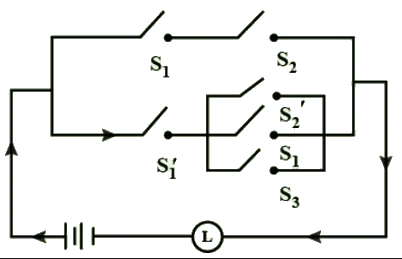
Consider the following statements p : the switch $\mathrm{S}_1$ is closed. q : the switch $\mathrm{S}_2$ is…
Consider the following statements p : the switch $\mathrm{S}_1$ is closed. q : the switch $\mathrm{S}_2$ is closed.
$r$ : the switch $\mathrm{S}_3$ is closed.
Then the switching circuit represented by the statement $(\mathrm{p} \wedge \mathrm{q}) \vee(\sim \mathrm{p} \wedge(\sim \mathrm{q} \vee \mathrm{p} \vee \mathrm{r}))$ is
Solution
Let \(p\) : the switch \(S_1\) is closed
\(q\) : the switch \(S_2\) is closed
\(r\) : the switch \(S_3\) is closed
\(\sim p\) : the switch \(S_1^{\prime}\) is closed or the switch \(S_1\) is open
\(\sim q\) : the switch \(S_2^{\prime}\) is closed or the switch \(S_2\) is open
\(\sim r\) : the switch \(S_3^{\prime}\) is closed or the switch \(S_3\) is open
The switching circuit corresponding to the given statement pattern is given::