A thermodynamic system is taken from an initial state with internal energy to the final state f along two different paths iaf and ibf, as schematically shown in the figure. The work done by the system along the paths af, ib and bf are and respectively. The heat supplied to the system along the path iaf, ib and bf are iaf ib and respectively. If the internal energy of the system in the state b is and , the ratio is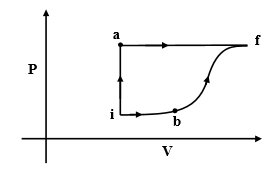
A thermodynamic system is taken from an initial state i with internal energy U i = 100 J to the final state…
Solution
| Process | W(in Joule) | (in Joule) | Q(in Joule)i |
| ia | 0 | ||
| af | 200 | ||
| Net | 300 | 200 | 500 |
Joule
Process ibf
| Process | W(in Joule) | (in Joule) | Q(in Joule)i |
| ib | 100 | 50 | 150 |
| Bf | 200 | 100 | 300 |
| Net | 300 | 150 | 450 |
`
Asked in: JEE Advanced 2014 (Paper 1)