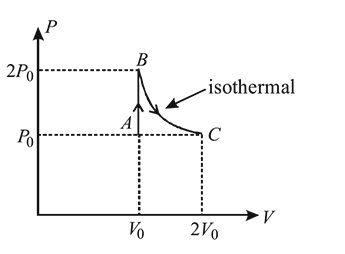
A diatomic ideal gas undergoes a thermodynamic change according to the P-V diagram shown in the figure. The…
A diatomic ideal gas undergoes a thermodynamic change according to the P-V diagram shown in the figure. The total heat given to the gas is nearly
$($ use $\ln 2=0.7)$
$2.5 P_{0} V_{0}$
$1.4 P_{0} V_{0}$
$1.1 P_{0} V_{0}$
$3.9 P_{0} V_{0}$
Solution
$Q_{A B}=\Delta U_{A B}+W_{A B}$
$W_{A B}=0$
$\Delta U_{A B}=\frac{f}{2} n R \Delta T \quad \Rightarrow \quad \frac{f}{2}(\Delta P V)$
$\Delta U_{A B}=\frac{5}{2}(\Delta P V) \Rightarrow Q_{A B}=2.5 P_{0} V_{0}$
Process $B C$ :
$Q_{B C}=\Delta U_{B C}+W_{B C}=0+2 P_{0} V_{0} \ln 2=1.4 P_{0} V_{0}$
$Q_{\text {net }}=Q_{A B}+Q_{B C}=3.9 P_{0} V_{0}$