A block of mass is attached to a massless spring with spring-constant This block is connected to two other blocks of masses and using two massless pulleys and strings. The accelerations of the blocks are and as shown in figure. The system is released from rest with the spring in its unstretched state. The maximum extension of the spring is Which of the following option(s) is/are correct?
[ is the acceleration due to gravity. Neglect friction]
A block of mass 2 M is attached to a massless spring with spring-constant k . This block is connected to two…
- When spring achieves an extension of for the first time, the speed of the block connected to the spring is
- At an extension of of the spring, the magnitude of acceleration of the block connected to the spring is
Solution

Using string constraint
is correct.
for other options use equivalent

Equivalent mass
Or Reduced mass
(for a two-mass system)
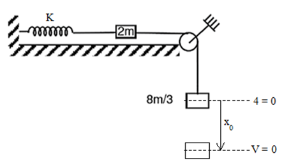
Using mechanical energy conservation
is incorrect
Option
Option
For a simple harmonic motion maximum displacement from extreme to extreme
and
and
Asked in: JEE Advanced 2019 (Paper 2)